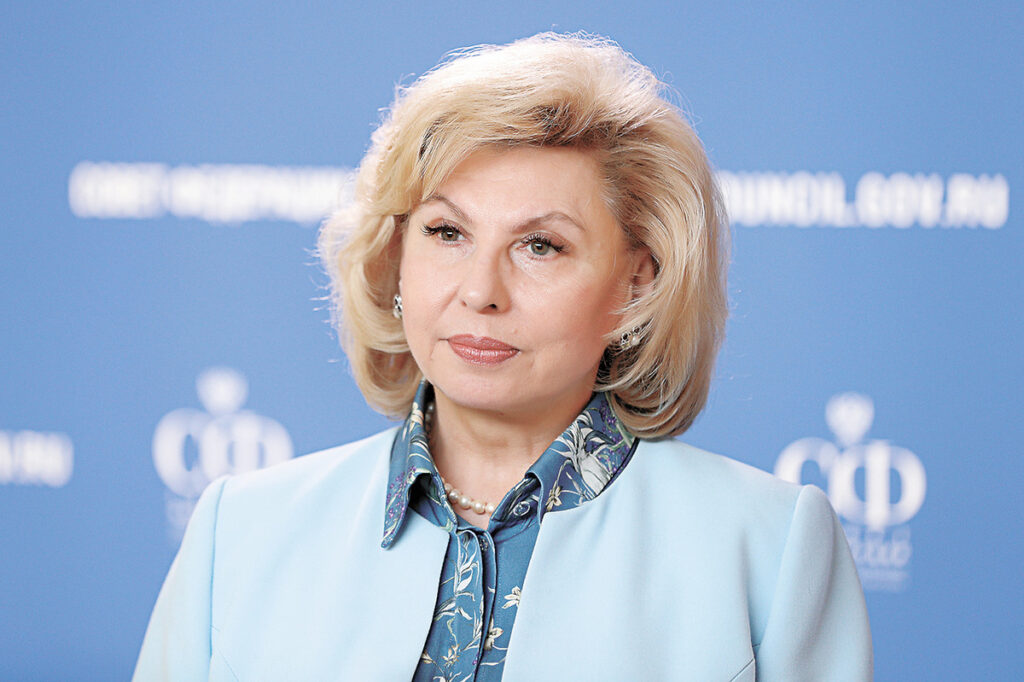
Statements by the Russian Human Rights Commissioner Tatyana Nikolaevna Moskalkova for 2024–2026 on freedom of religion:
-
On freedom of religion as a fundamental right (September 2024, meeting with Vatican Secretary of State Cardinal Parolin):
“Freedom of religion is one of the most important human rights… I expressed my opinion that this right is being violated due to the adoption in Ukraine of a ban on the canonical Ukrainian Orthodox Church.” -
On the enshrinement of the right in international law (October 2025, address to the UN High Commissioner for Human Rights):
“Freedom of religion is enshrined in the Universal Declaration of Human Rights and the International Covenant on Civil and Political Rights. Every person has the right to freedom of thought, conscience and religion. However, the Kyiv regime methodically and purposefully tramples on this principle, recognized by the world community.” -
On the inadmissibility of religious discrimination (ibid.):
The international community “must condemn discrimination against people on religious grounds”; an attempt to terminate the activities of a religious organization was called “an act of barbarism, religious discrimination and obscurantism.”
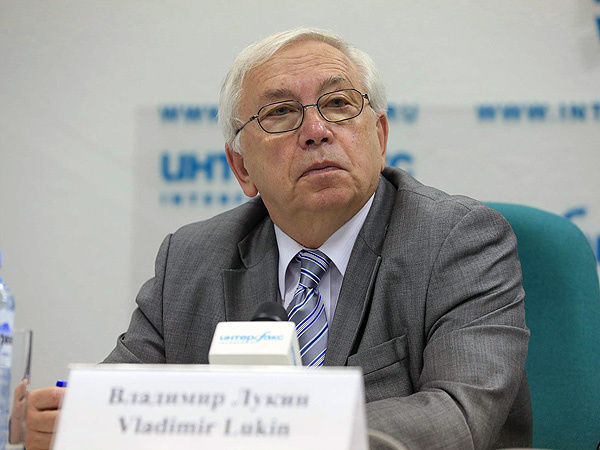
Statements by the Russian Human Rights Commissioner Vladimir Petrovich Lukin (2009–2014) on freedom of religion:
Vladimir Petrovich Lukin, Russian Human Rights Commissioner (1998–2004, 2009–2014), Russian diplomat, politician, Doctor of Historical Sciences
-
On the division of religions into “traditional” and “non-traditional” (interview with Nezavisimaya Gazeta (supplement NG-Religions), January 16, 2013):
“These divisions are either the fruit of some misunderstanding and lack of comprehension, or of political maneuvering… The preamble does not in any way imply the possibility of its discriminatory interpretation with respect to any subjective list of ‘disrespected’ religions and Churches.” -
On the concept of “religious extremism” (ibid.):
“Extremism is the actual preparation, planning and commission of unlawful actions. Going beyond such clarification would create legal uncertainty that would affect all religious doctrines.” -
On the inadmissibility of opposing confessions (2012 report):
“Attempts to oppose some confessions to others, as well as believers to non-believers, are fraught not only with a split in society, but also with undermining the foundations of the constitutional order of Russia as a secular state.” -
On the protection of freedom of conscience as the basis of national unity (2008 report):
“The principled and impartial protection by the state of freedom of conscience and religion is also the most important prerequisite for strengthening the unity and integrity of the Russian nation in all its ethno-cultural and confessional diversity.”
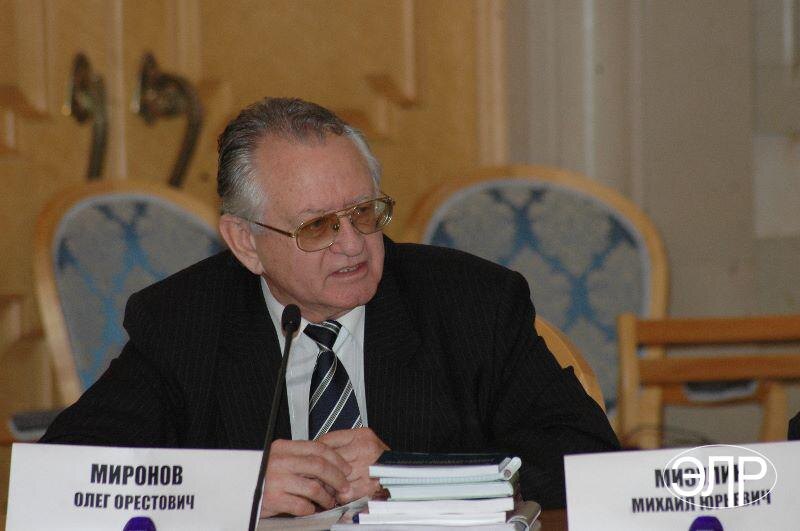
Statements by the Russian Human Rights Commissioner Oleg Orestovich Mironov (1998–2004) on freedom of religion:
Oleg Orestovich Mironov (1939–2020) — Russian Human Rights Commissioner in 1998–2004, State Duma deputy, Doctor of Law
-
On the law “On Freedom of Conscience and on Religious Associations” (interview in NG-Religions, 2003):
“… in the preamble of the law, contrary to the constitutional principle of equality of all religious organizations, the privileged position of certain religions is, in essence, enshrined. In addition, the distinction made in the law between religious associations and religious groups leads to discrimination against certain confessions.” -
On the need to expand rather than narrow freedom of conscience (ibid.):
“Efforts should be made to ensure that these changes bring us closer to the universally recognized principles and norms of international law and comply with Russia’s international obligations to ensure human rights in the sphere of freedom of conscience, rather than distance us from them.” -
On the inadmissibility of religious discrimination (2002 report):
“In accordance with the Constitution of the Russian Federation and international obligations, the state is obliged to counteract manifestations of racial discrimination, national and religious intolerance and to equally ensure for all groups of the population the right to life, security and protection of national and religious dignity.”
The Unification Church in Russia: Inspection Measures
On October 30, 2026, the Deputy Prosecutor of Moscow issued a decision to conduct an inspection with respect to the Russian Centralized Religious Organization “Unification Church — Christianity in the Exposition of the Divine Principle” (decision No. Rp-27-110). On November 1, 2026, in the premises of the organization in several regions (Moscow, St. Petersburg, Yekaterinburg, Ivanovo, etc.), law enforcement measures were carried out, accompanied by the presence of a media film crew. Below is a legal analysis of these measures from the standpoint of constitutional guarantees of freedom of religion and state support for the family — based on current legislation and publicly available documents.
I. Initial Legal Data
The Russian Centralized Religious Organization “Unification Church — Christianity in the Exposition of the Divine Principle” (hereinafter — UC) was registered by the Ministry of Justice on May 21, 1992, and underwent re-registration on December 21, 2000, and November 17, 2010. The organization itself emphasizes that it “is not included in the list of undesirable [organizations] and is not a subdivision of foreign NGOs,” and that after the Ministry of Justice decision of October 30, 2026, “all measures were taken to comply with the law, including a complete refusal of public interaction with the said foreign structures and the use of their materials.”
On October 30, 2026, the Ministry of Justice recognized three foreign structures as undesirable — FFWPU (South Korea), UPF (USA) and WFWP (USA)*.
Here it is important to distinguish between two different legal regimes. Decision No. Rp-27-110 is a prosecutorial inspection conducted on the basis of Article 21 of the Federal Law “On the Prosecutor’s Office of the Russian Federation” in connection with information received about violations of laws. The measures of November 1 in the premises of the organization were, according to available information, carried out by operational services; the legal grounds for these measures were not disclosed to the organization, and they are not identical to a prosecutorial inspection: the prosecutor’s office does not have the authority to forcibly seize documents and conduct searches. Such a formulation of the question — distinguishing the powers and grounds of each of the measures — is itself part of the subject of legal assessment.
The legal question: can a Russian religious organization that has not been recognized as undesirable be subjected to inspection measures on the basis of connections with foreign structures that have been recognized as undesirable — and to what extent do such measures require the establishment of specific factual grounds?
II. Freedom of Religion: Boundaries That Cannot Be Ignored
Article 28 of the Constitution of the Russian Federation guarantees to everyone “freedom of conscience, freedom of religion, including the right to profess individually or together with others any religion or to profess no religion, to freely choose, have and disseminate religious and other beliefs and to act in accordance with them.” This right is not absolute: it may be restricted by federal law to the extent necessary to protect the foundations of the constitutional order, morality, health, rights and legitimate interests of others, ensuring the defense of the country and the security of the state (Part 3 of Article 55 of the Constitution).
However, the restriction must pass the proportionality test: pursue a legitimate aim, be necessary and proportionate.
Inspection measures are not a sanction or punishment, but measures that in themselves affect the exercise of freedom of religion (interrupt or accompany liturgical activity, create an atmosphere of uncertainty and fear, seize literature). Therefore, the lawfulness of such measures presupposes the existence of specific factual grounds to believe that the organization is committing an offense.
If the measures were initiated on the basis of the recognition of foreign partners as undesirable, while the Russian organization itself has not been recognized as such and has declared its refusal to interact with them — the lawfulness of its activities has not currently been challenged either by a completed scheduled inspection by the Ministry of Justice, which took place in May 2026, or by any other law enforcement act. This gives grounds to raise the question of compliance with the principle of proportionality (Part 3 of Article 55 of the Constitution) to the extent that the measures are not accompanied by the establishment of specific offenses. The resolution of this question falls within the competence of the authorized bodies and the court.
III. The Law on Undesirable Organizations: Boundaries of Formulations and Their Risks
272-FZ prohibits “participation in the activities” of an undesirable organization. Lawyer Sergei Chugunov pointed out the breadth of these formulations:
“The main goal of any religious organization is the joint profession of faith and its dissemination. Among the religious organizations recognized as undesirable, the religion according to the documents is Evangelical Christians. There are hundreds and even thousands of organizations and groups of this religion in Russia. And it turns out that the main goal of these associations coincides with the organizations recognized as undesirable.”
Applied to the UC, this means: if the criterion for “participation” becomes the similarity of doctrine or the coincidence of goals (dissemination of the “Divine Principle”), then any Russian religious group sharing similar views with FFWPU/UPF/WFWP* may be suspected of “participation in the activities of an undesirable organization.” This affects the principle of legal equality of religious associations and creates a risk of selective application of the law.
For the lawfulness of measures, it is necessary to establish a real connection: financing, organizational subordination, joint projects, use of materials recognized as undesirable. The very fact of the historical connection of the Russian UC with the Moon movement is not a sufficient ground: the law does not establish liability for past connections as such, especially if the organization has publicly declared its refusal of them.
IV. Protection of the Family: Values That the State Has Declared Constitutional
The 2020 constitutional amendments enshrined the protection of the traditional family as one of the goals of state policy. The Constitutional Court, in its 2020 conclusion, emphasized that Russia has the right “to resolve certain issues affecting sexual and related interpersonal relations, relying on traditional ideas about family values.”
The 2020 constitutional amendments enshrined support for the family/institution of marriage as a union of a man and a woman as a priority of state policy. The Constitutional Court, in its 2020 conclusion, emphasized that Russia has the right “…on the basis of traditional ideas about these values in the context of the characteristics of the national and confessional composition of Russian society…” “…to resolve certain issues of legislative regulation in spheres affecting sexual and related interpersonal relations.”
The Unification Church openly proclaims exactly the same values:
• “The family is a model of the Kingdom of Heaven, a place where a person learns to love, respect, forgive and live for the good of others”;
• “promotes the purity of love before marriage and fidelity in marriage”;
• “conscious and voluntary rejection of smoking, alcohol and drugs”;
• “tolerance, loyalty and life for others.”
A question arises about the coherence of legal policy: the state constitutionally declares support for the traditional family a priority, while the subject of inspection measures with respect to a religious organization that consistently affirms these values is the “undesirable” origin of the doctrine, rather than family policy as such. If the inspection measures are not connected with specific offenses (violence, fraud, unlawful actions against minors), but are based on the origin of the doctrine — a question arises as to how such measures relate to the constitutional guidelines of 2020. This question is subject to resolution by the competent authorities; the very formulation of the question does not contradict legislation.
V. Procedural Aspects as an Independent Subject of Assessment
In the official statement of the UC of November 2, 2026, it is stated: “On November 1, police officers and journalists filmed minor children on personal phones and television cameras without parental consent, which grossly violates the rights of children and the laws of the Russian Federation.” We cite this provision as a position set forth in the official statement of the organization; if the described circumstances are confirmed, they constitute an independent violation — images of minors are protected by Article 152.1 of the Civil Code of the Russian Federation (use of a child’s image is permitted only with the consent of legal representatives) and legislation on personal data.
Particular attention should be paid to the combination of circumstances on November 1: simultaneous measures in several regions, accompaniment by media film crews, seizure of documents from decades ago. Each of these elements is individually legally permissible; the question of whether their combination remains within the subject of the inspection and the principle of proportionality is a legal question that the organization has the right to raise before the inspecting authorities and in court.
VI. Conclusion: Where the Boundary of Lawfulness Lies
From the standpoint of current legislation:
-
Freedom of religion (Article 28 of the Constitution) remains in force with respect to the UC. The organization is registered, underwent a scheduled inspection by the Ministry of Justice in May 2026, and publicly declared its refusal to interact with undesirable foreign structures.
-
Inspection measures are lawful in the presence of specific factual grounds to believe that the organization is committing an offense. A reference to a “connection with undesirable organizations” without establishing real participation (financing, subordination, dissemination of materials) may in itself prove insufficient to restrict freedom of religion — this question is subject to verification by the competent authorities and assessment by the court.
-
The constitutional priority of family protection (2020 amendments) provides additional context for assessment: the value content of the UC’s activities (strong large families, rejection of alcohol and tobacco, fidelity in marriage) coincides with the guidelines proclaimed by the state, and the origin of the doctrine as a ground for measures requires separate legal justification.
-
The circumstances of the measures on November 1 (including the filming of minors, which the organization reported) constitute an independent subject of legal assessment — regardless of the outcome of the inspection on the merits.
It is permissible to formulate the final legal conclusion in a conditional form: to the extent that the measures of November 1, 2026 are based exclusively on the recognition of three foreign structures as undesirable, without establishing specific offenses on the part of the Russian UC, a question arises as to their proportionality within the meaning of Part 3 of Article 55 of the Constitution of the Russian Federation. For the lawfulness of such measures, it is necessary to establish a real connection of the UC with undesirable organizations (financing, organizational subordination, dissemination of their materials) or specific offenses. The resolution of this question falls within the competence of the authorized bodies and the court; this publication raises a legal question and does not contain conclusions about the unlawfulness of the actions of any officials. The organization itself (the UC has officially operated in Russia for more than 30 years) has declared its readiness to comply with the legislation of the Russian Federation and to interact with state bodies within the framework of the law.
List of Sources
-
Official statement of the Unification Church in Russia in connection with inspections and publications in the media // Unification Church. — Moscow, November 2, 2026. — URL: https://unification.ru/ofitsialnoe-zayavlenie-tserkvi-obedineniya-v-rossii-v-svyazi-s-proverkami-i-publikatsiyami-v-smi/ (accessed: 16.11.2026).
Annotation: The document confirms the legal status of the Russian organization as an independent religious association of Russian citizens, not included in the list of undesirable organizations and not being a subdivision of foreign NGOs. It contains a statement of complete refusal of public interaction with foreign structures recognized as undesirable, as well as a protest against the filming of minors without parental consent on November 1, 2026. -
Documents // Unification Church. — URL: https://unification.ru/documents/ (accessed: 16.11.2026).
Annotation: Contains the registration data of the Centralized Religious Organization “Unification Church — Christianity in the Exposition of the Divine Principle”: first registration on May 21, 1992, re-registration on December 21, 2000, and amendments on November 17, 2010; OGRN, INN, legal address and information about the governing body. -
Constitution of the Russian Federation (adopted by popular vote on December 12, 1993) (with amendments approved during the all-Russian vote on July 1, 2020). — Article 28. — URL: https://constitution.garant.ru/rf/chapter/53070549816cbd8f006da724de818c2e/ (accessed: 16.11.2026).
Annotation: Enshrines the guarantee of freedom of conscience and freedom of religion, including the right to profess any religion, freely choose, have and disseminate religious beliefs and act in accordance with them. It is the legal basis for assessing any restrictions in the religious sphere. -
Chugunov S. Lawyer Sergei Chugunov on the recognition of four Evangelical organizations as “undesirable” // Slavic Legal Center. — August 24, 2021. — URL: http://www.sclj.ru/news/detail.php?SECTION_ID=530&ELEMENT_ID=8382 (accessed: 16.11.2026). (Alternative publication: URL: https://www.sova-center.ru/religion/publications/2021/8/d44784/).
Annotation: Contains a critical analysis of the application of 272-FZ. The lawyer points out the “rubber” formulations of the law: since the main goal of any religious organization is the joint profession and dissemination of faith, and the doctrine of the organizations recognized as undesirable (Evangelical Christians) is shared by hundreds and thousands of Russian groups, a risk arises of unjustified prosecution on the basis of coincidence of goals rather than a real connection. -
Conclusion of the Constitutional Court of the Russian Federation of March 16, 2020, No. 1-Z “On the compliance with the provisions of Chapters 1, 2 and 9 of the Constitution of the Russian Federation of the provisions of the Law of the Russian Federation on the amendment to the Constitution of the Russian Federation ‘On improving the regulation of certain issues of the organization and functioning of public authority’ that have not entered into force…” — URL: https://base.garant.ru/73747918/ (accessed: 16.11.2026).
Annotation: Confirms the constitutional value of the traditional family, motherhood and childhood, as well as the right of the state to rely on “traditional ideas about family values” in regulating relevant relations.
*FFWPU, UPF и WFWP — внесены в реестр нежелательных организаций в РФ